Understand
Read a principle and work through a fictional situation.
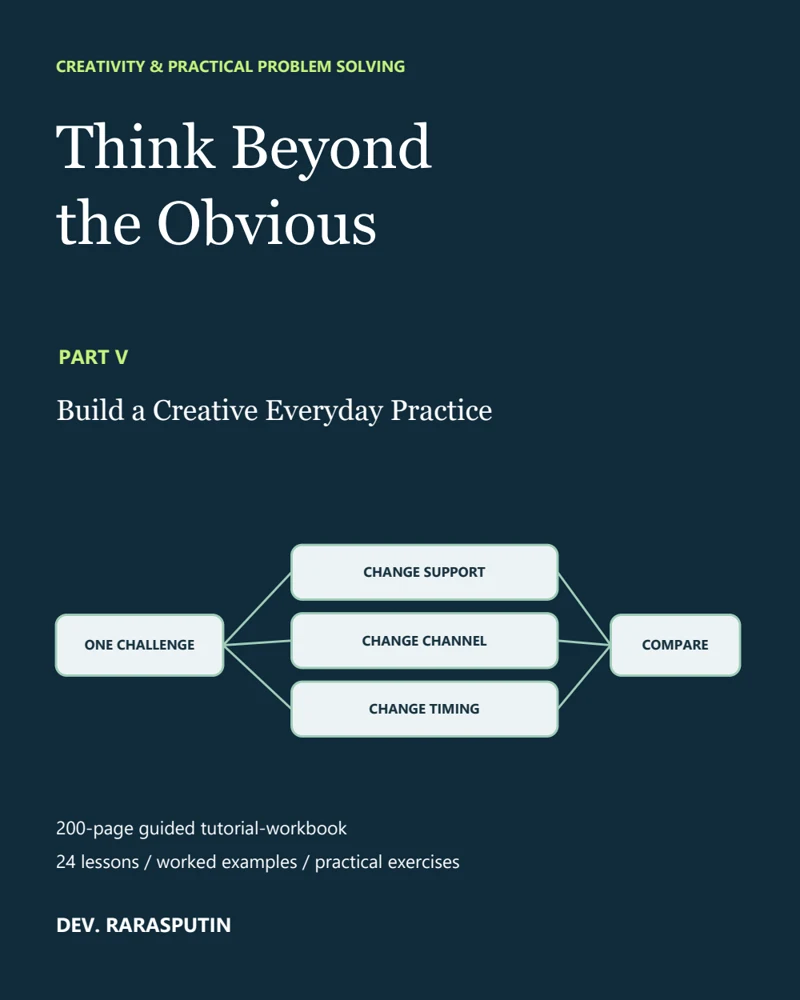
Creativity & practical problem solving / Part V
Collaborate, get unstuck and complete a practical capstone.
200-page tutorial-workbook / 24 lessons / $5 USD
Get Part V - $5Substantial guided writing and planning space. PDF plus practical templates; each part is sold separately.
Learn by doing
Read a principle and work through a fictional situation.
Inspect two routes and the assumptions behind them.
Apply the skill to one manageable real challenge.
Record evidence, limits and your next useful decision.
A fictional worked example
Asha wants a daily hour of brainstorming but rarely has that time.
She chooses one weekly friction to frame and one alternative to explore.
A short repeatable practice is easier to evaluate than an idealized schedule.
Illustrative teaching example, not a testimonial or measured result.
Explore the sample lessonInside this volume
A routine should make it easier to return to meaningful work. Link it to an existing opportunity and define a useful output. A long ritual can become another obstacle.
Try it: Design a routine that fits an ordinary crowded week.
Check: What useful artifact will the practice leave behind?
An observation bank preserves concrete frictions, questions and workarounds for later attention. Record context, not just an abstract idea. Keep personal details out when they are unnecessary.
Try it: Record three ordinary observations during a week.
Check: What detail would help you reconstruct the situation later?
A mechanism library records how useful ideas work: making status visible, moving information earlier or reducing a handoff. Organize by function so the lesson can transfer beyond the original object.
Try it: Add three mechanism cards from familiar services.
Check: What conditions make the mechanism useful?
A defined first action can reduce the effort of beginning without promising a creative breakthrough. Prepare a concrete prompt and materials. Judge the session by the work attempted rather than an emotional state.
Try it: Write an opening action for a task you keep postponing.
Check: What can you do without waiting for a particular feeling?
A break can interrupt unproductive repetition, but it helps to define where you will resume. Write the current question and next step before stopping. Avoid turning a pause into indefinite abandonment.
Try it: Prepare a pause note and a specific next action.
Check: What will you do first when you return?
A rut may come from a vague brief, missing information, narrow inputs, premature judgment or exhaustion. Choose a response that fits the obstacle. More brainstorming is not the answer to every difficulty.
Try it: Use a stuck-work audit on one current project.
Check: Which obstacle is most consistent with the evidence?
Writing, speaking, sketching and arranging cards reveal different relationships. Switching modes can expose what is hard to see in the current format. Keep the problem constant long enough to compare the effect.
Try it: Represent one problem in words, a sequence and a diagram.
Check: What became visible in the new representation?
Confidence can grow from seeing yourself complete useful actions and respond to feedback. Keep a record of specific attempts and learning rather than making broad claims about talent. Difficulty can coexist with progress.
Try it: List three concrete actions you have learned to perform.
Check: What can you do now that you could not do before?
A focused feedback request tells the reader what kind of response would help. Ask about a mechanism, confusing point or missing constraint. Separate encouragement from evidence about the idea.
Try it: Write a feedback request with one precise question.
Check: What decision will the feedback inform?
Feedback is input to evaluate, not an order to obey or an attack to reject. Understand the observation behind a suggestion. Compare it with the intended outcome and other evidence.
Try it: Sort feedback into observation, interpretation and proposed solution.
Check: What is the strongest useful observation in the critique?
A group session needs a focused question, participation method and defined output. Explain whether the current phase is generating, developing or choosing. Make it possible to contribute without speaking fastest.
Try it: Plan a short session with clear phase boundaries.
Check: What should exist at the end that does not exist now?
People vary in comfort with public speaking, rapid writing and visual tasks. Offer workable alternatives and time to prepare where feasible. Ask about practical access needs without demanding personal explanations.
Try it: Adapt a session so people can contribute in more than one way.
Check: Whose contribution is the format making difficult?
A confident speaker can unintentionally narrow the pool. Use turn structure and private idea capture to separate authority from idea quality. Apply the rule consistently rather than singling someone out publicly.
Try it: Write a facilitator phrase that protects space for other input.
Check: Which rule separates contribution from rank?
Disagreement can reveal missing facts or competing priorities. Ask people to explain the condition under which their view makes sense. Keep criticism attached to the proposal and the brief.
Try it: Write both sides of a disagreement as reasonable concerns.
Check: What evidence or authority could resolve the actual difference?
An action needs a person, a deliverable, a time boundary and a dependency check. Shared enthusiasm does not assign responsibility. Confirm the commitment with the person expected to do the work.
Try it: Convert three vague next steps into owned actions.
Check: Has the responsible person accepted the commitment?
A brief limits scope while a review point allows useful changes. New ideas can be recorded for later rather than inserted immediately. Change the scope when evidence warrants it, with the right agreement.
Try it: Create a current scope and a later-ideas list.
Check: Which new information justifies changing scope now?
An adopted change needs maintenance, ownership and a route for corrections. Plan these before declaring the project complete. A once-clear guide can become confusing when dates or rooms change.
Try it: Write a maintenance note for one adopted idea.
Check: Who keeps the result accurate next month?
Stopping can be a reasoned choice when a concept does not help, costs too much or no longer fits. Preserve the learning and release obligations cleanly. Do not treat every stopped idea as wasted effort.
Try it: Write a stop note for an idea that no longer deserves effort.
Check: What must be closed or communicated when the idea ends?
A portfolio shows a range of briefs, alternatives, tests and revisions. It makes learning visible beyond finished successes. Include changes of mind and stopped ideas with reasons.
Try it: Select three attempts that taught different skills.
Check: What did you learn from an attempt you did not adopt?
A useful principle can travel while the exact implementation changes. Name the mechanism and inspect new users, resources and constraints. A familiar solution can fail in a different environment.
Try it: Apply one mechanism to a different ordinary setting.
Check: Which changed condition needs fresh evidence?
An AI assistant can suggest alternatives or challenge assumptions, but its output is material to inspect. Give a non-sensitive brief, ask for different mechanisms and verify factual claims. Human judgment and affected people's input remain necessary.
Try it: Write a prompt that asks for mechanisms and explicitly marks unknown facts.
Check: Which suggestion needs real-world verification before use?
A capstone integrates framing, generation, comparison and testing around one modest challenge. Keep the commitment small enough to finish and review. Reuse the earlier records rather than starting from a polished conclusion.
Try it: Prepare a capstone plan with evidence and responsibility at each stage.
Check: What will make this project finishable and worth doing?
A final presentation should show the problem, alternatives, evidence and next decision. Distinguish observed results from expectations and disclose limits. A clear explanation is more useful than a dramatic success story.
Try it: Create a five-minute case explanation with one limitation visible.
Check: Could a reader challenge your conclusion using the evidence you provide?
Finishing the series is a starting point for selective practice. Choose one skill that would improve your next ordinary project and define an observable action. Keep the plan small enough to review rather than adopting every method at once.
Try it: Write a next-project agreement with yourself and a review date.
Check: Which single skill deserves your next intentional attempt?
Your working space
Choose a lesson, describe your challenge and keep the reasoning visible. Save stores entries in this browser only. Download a copy for another device. There is no account or cloud sync.
The complete learning path
Each volume contains 200 numbered pages, including substantial practice and writing space. This is a tutorial-workbook series, not a video course or interactive PDF form. Ordinary examples are fictional. Results depend on context, judgment and practice.